
Jelly Roll Concert at the Honda Center in Anaheim, CA with Nicole. 7-Sept-2024.
Pdawg Entertainment
Jelly Roll Concert at the Honda Center in Anaheim, CA with Nicole. 7-Sept-2024.
Howard Schultz, the legendary former CEO of Starbucks, offers profound insights into business leadership and entrepreneurship in his masterclass. Here are the essential lessons he shares for aspiring business leaders:
Jump In, But Be Prepared
Schultz believes we live in an unprecedented time of opportunity for entrepreneurs, with easily available technology, accessible capital, and global markets. However, he emphasizes that success requires both discipline and a clear understanding of what you’re willing to sacrifice. The key is to weigh both the cost of jumping in and the cost of not taking the leap – because as Schultz notes, “regret is expensive.”
Values and Profits Are Not Enemies
One of Schultz’s most compelling insights is that company values and profitability aren’t opposing forces – they’re complementary. He demonstrates this through Starbucks’ early decision to offer health insurance and stock options to part-time workers, a values-based choice that helped attract and retain loyal employees while differentiating the company in the marketplace.
The Power of Curiosity and Continuous Learning
At 65, Schultz emphasizes the importance of remaining curious and constantly seeking new knowledge. He advocates for putting yourself in uncomfortable positions to learn, embracing failure as a teacher, and seeking mentorship opportunities – both as a mentee and mentor.
Disrupt, Don’t Pioneer
Interestingly, Schultz advises against being a pioneer in entirely new markets. Instead, he recommends disrupting existing categories with innovative approaches. He cites Allbirds as an example, which successfully entered the crowded shoe market through unique materials, competitive pricing, and strong emotional connection with customers.
Focus and Financial Discipline
Schultz stresses the importance of maintaining clear focus on 3-5 key objectives rather than chasing too many goals. He provides specific metrics for retail success, such as aiming for a 2:1 sales-to-investment ratio and a 20% operating margin.
Culture as Foundation
Perhaps most importantly, Schultz emphasizes the critical importance of company culture. He compares building business culture to raising children – it requires early imprinting of core values and direction. The culture should reflect the company’s mission and values, and leaders must move swiftly to address any inconsistencies.
Leadership in Crisis
Schultz offers valuable insights about leadership during difficult times. He emphasizes the importance of transparency with employees during crises, making tough decisions quickly when necessary, and maintaining company values even when under pressure to prioritize the bottom line.
The blog post wouldn’t be complete without mentioning Schultz’s famous attention to detail – even including his personal method for preparing the perfect French press coffee, symbolizing how leadership excellence often comes down to caring about the smallest details while never losing sight of the bigger picture.
For aspiring entrepreneurs and business leaders, Schultz’s masterclass serves as a reminder that success in business isn’t just about profit margins and market share – it’s about building something meaningful and enduring through strong values, constant innovation, and genuine leadership.
His final message is particularly encouraging: while there is no straight line to success, many of the challenges you’ll face can be solved through intuition and life experience rather than textbook knowledge. It’s a reminder that leadership is as much about personal growth and wisdom as it is about business acumen.
RF Microneedling is a popular treatment known for enhancing skin texture, reducing wrinkles, and promoting collagen production. I just received RF Microneedling few days ago on the lower half of my face and under chin area. It’s my first time doing it. I am excited to see the results.
If you’ve recently undergone this procedure, adhering to the post-treatment instructions is crucial for optimal results and a smooth recovery. Here’s a comprehensive guide to help you navigate the aftercare process. Note what is written here is just opinion and does not constitute any sort of medical advice.
Immediate Aftercare:
Day-by-Day Recovery:
What to Avoid:
First Week Protocol:
Long-Term Care:
Improvements will continue over the next 4-6 months as collagen rebuilds.
Book Title: Analysis and Summary of “The Checklist Manifesto” by Dr. Atul Gawande
In “The Checklist Manifesto,” Dr. Atul Gawande explores the profound impact of simple checklists in complex and high-stakes industries like medicine, aviation, and construction. Drawing from his experiences as a surgeon and extensive research, Gawande illustrates how meticulously crafted checklists can reduce human error, enhance communication, and save lives.
Key Highlights:
Conclusion: “The Checklist Manifesto” is a thought-provoking work that challenges conventional wisdom and advocates for the widespread adoption of checklists across various domains. Gawande’s engaging writing and thorough research leave readers with a deep appreciation for the transformative potential of the humble checklist.
By adopting the principles outlined in “The Checklist Manifesto,” professionals in any field can enhance their performance, ensure safety, and achieve better outcomes through the disciplined use of checklists. This book is a must-read for anyone looking to improve their workflow and reduce errors in complex environments.
Introduced by Eliott Goldratt in The Goal.
More details here: https://www.tocinstitute.org/five-focusing-steps.html
#throwback

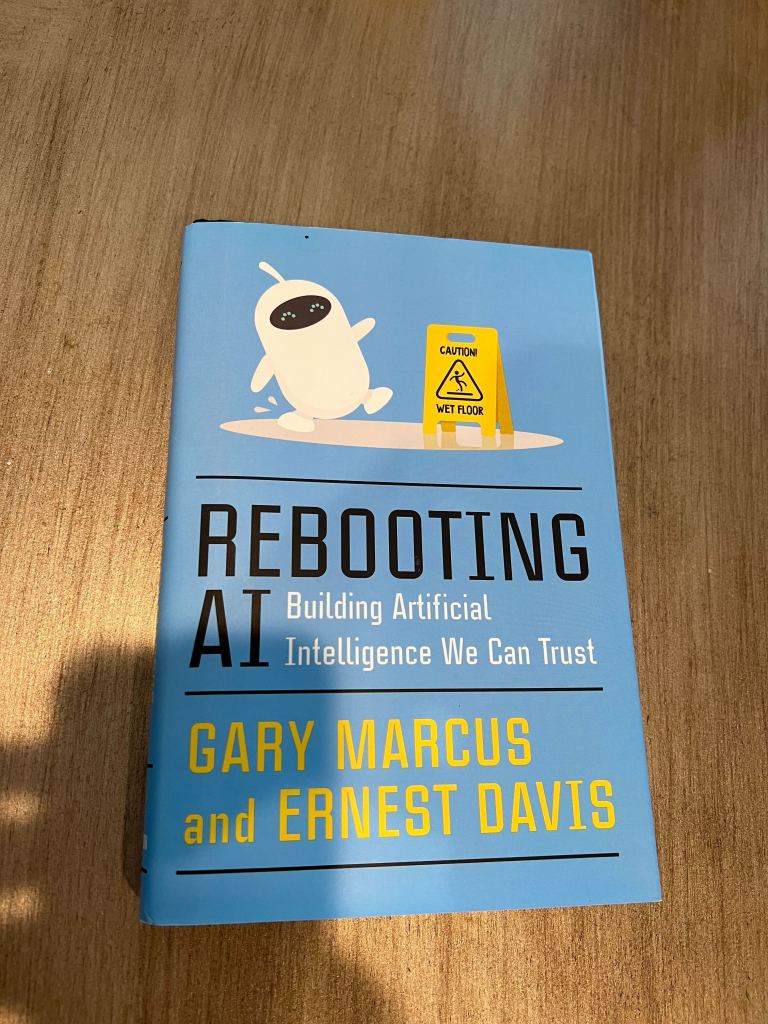
I enjoyed reading Rebooting AI — building Artificial Intelligence We Can Trust (published in 2019). Gary and team survey progress in AI and some of the shortcomings with the latest approaches such as Deep Learning. For AI to make next leap, Gary and team argue that AI needs to have some basic common-sense built into it, which current approaches largely overlook. This book is an easy-read and will provide value to readers interested in artificial intelligence, shortcomings (which is somewhat contrarian given the hype that media continues to give to AI) and its impact to society.
Popular insertion sort algorithm written in Ruby.
sampleList = [12, 11, 13, 5, 6]
sortedSampleList = []

sampleList.each_with_index do |inputtedItem, inputtedItemIndex|
    if sortedSampleList.length == 0
        sortedSampleList.insert(0, inputtedItem)
        next
    end
    sortedSampleList.each_with_index do |outputtedItem, outputtedItemIndex|
        if inputtedItem < outputtedItem
            sortedSampleList.insert(outputtedItemIndex, inputtedItem)
            break
        elsif outputtedItemIndex == sortedSampleList.length - 1
            sortedSampleList.insert(sortedSampleList.length, inputtedItem)
            break
        end
    end
end

p sampleList
p sortedSampleList
The output is the following.
% ruby insertionSort.rb
[12, 11, 13, 5, 6]
[5, 6, 11, 12, 13]
 Pdawg
Pdawg 